The Basics of Sheet Metal Forming with a Hydraulic Press

What is the Deep Drawing Metal Forming Process?

The metal deep draw stamping process is a cold-forming process, meaning it is performed in an environment at or near room temperature. In this forming process, a flat metal blank is stretched over a die cavity with a punch on a hydraulic or mechanical press. As the material is drawn into the die cavity, it flows to form over the shape of both the die and the punch, taking its shape. This often results in a cup, enclosure, dome, or housing.  

Deep drawing is a popular manufacturing process as compared to others because of its ability to form a one-piece construction, rather than turning to welding, or a multi-piece assembly involving multiple step processes. It is more timely, cost-effective, and efficient to utilize our deep draw presses. 


To classify a part as deep-drawn depends on its height to depth ratio, or H/D ratio. When these ratios are large enough to classify as a deep draw is when other processes would not be able to achieve the final product in one step. If another process would be used, the design would need to be separated into a multi-stage construction. This is because the material would be pushed beyond its mechanical limits. Deep Drawing is one of the few metal forming processes where extreme H/D ratios can be achieved with a single parent blank.  

What is the difference between Deep Drawing and Metal Spinning?

We compare deep drawing to metal spinning at TMS, because consistent wall thicknesses are easier to estimate and achieve with deep draw forming, rather than metal spinning. Deep drawn parts are cold-formed, which means that the amount of stress in the part is far less than in a spun part. Deep drawing allows for a larger batch of products to be finished, much quicker than if we were to spin them. 

How Accurate is the Deep Drawing Process?

The accuracy of a deep drawn part depends on a few different variables including our laser cut blank tolerance, inner diameter, outside diameter, wall length, and material type. These all affect the tolerance of the final deep drawn product. If the incoming material, the laser cut blank, from run to run is consistent, the press tool is capable of holding that +/-.010” from run to run. Consistency is one benefit to our deep drawing capabilities. In terms of final product tolerance, we meet or exceed our +/- 0.030” tolerance with all of our deep drawn parts. However, there are certain parts where the overall form is consistent within 0.010”. 


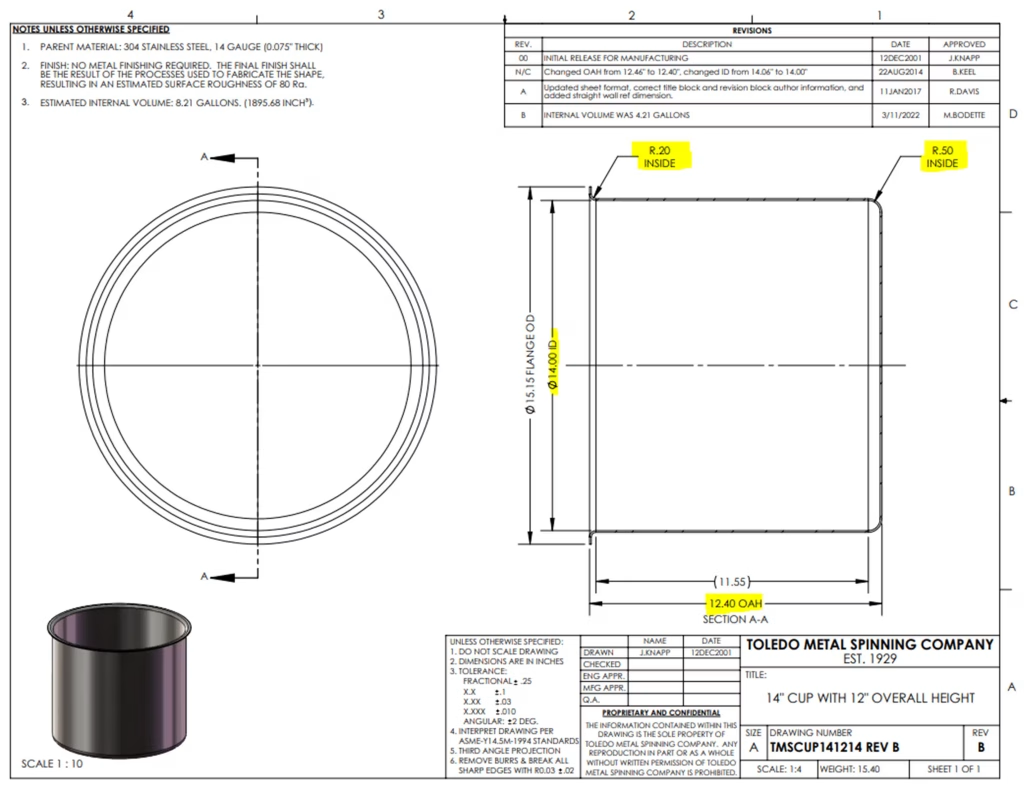
Below, the drawing of popular TMS deep drawn cup, TMS141214, indicates critical values to the deep draw process. Each part has what we call ‘tool-controlled’ features, meaning that the specific deep draw tool feature forming that detail will be extremely accurate every time. Examples of tool-Controlled features would be these radii on this cup (R.50 and R.20 in the drawing below). Those features will be exactly that value, every single time. The ID and OAH features may vary but can be dialed in to be the +/- 0.010”. The wall thickness on the cup can also vary but much less – about +/- 0.005”

Drawing for 12" stainless steel cup

What Material is Used for the Deep Draw Process?

Typical deep drawn materials, in order of what we prefer: 

  •  Stainless Steel
  • Cold Rolled Steels (CRS)
  • Copper / Brass
  • Aluminum

Stainless and cold rolled steels are somewhat close in preferability for deep drawing. Stainless is the ‘easiest,’ and will achieve deeper draws than Cold Rolled Steel, but both are good options.  Aluminum would be a better option for stamping, rather than deep drawing. The nature of the aluminum does not make it a great candidate for super deep drawing applications. However, we are still able to use it for some draws. 

How do you Prevent Wrinkles in Sheet Metal Forming?

Wrinkling in drawing, stamping, or deep drawing is due to the condition of the material, or blank, flow not being adequately controlled or restrained. 

Wrinkling is prevented by a combination of tool design, lubrication, and “pinch pressure” (settings on the machine) all balanced to restrict material flow. For tool design, minimum proper material clearances are integrated into the tool design based off the incoming blank thickness. This is to minimize the clearance provided for the material to move through. Less clearance = less material flow 

 Lubrication is also very important; we use different lubrications for each material, and if wrinkling happens during development- a thinner lubricant with a lower heat tolerance may be selected to help minimize the occurrence of that.

Less lubrication = less material flow

Lastly, the material (the blank) is constrained during the draw between two tool steels; the Draw Ring and the Top Die. These two tools pinch the blank, as the press draws down the plug to restrict material flow. This pinch pressure can be adjusted and customized by the die setter to be different values at different points in the draw height, all to balance the restriction of material flow.

More pinch pressure = less material flow

Contact us today for your deep drawn metal forming needs!

Related Articles

Deep Draw Sheet Metal Stamping for Strength and Efficiency

Deep Draw Metal Stamping for Strength and Efficiency The deep drawing sheet metal forming process  is a cold-forming metal fabrication process that is conducted in a room-temperature environment. A metal blank is stretched around a die cavity, eventually conforming to the shape of the plug, shape of the die, and the depth of the draw.

Read More »

Benefits of Sheet Metal Stamping

Benefits of Forming Deep Drawn Metal Stamped Parts The deep drawing sheet metal forming process is a cold-forming process performed in an environment at or near room temperature, where the metal is permanently deformed into the desired geometry. In this process, the flat metal blank is formed and stretched around a die cavity with a

Read More »

Secondary Metal Fabrication Process: Trimming

What is the Trimming Process and How is it Performed? Trimming is a process used to remove excess material to achieve a desired shape, size, and finish, while removing burrs and smooths out sharp edges. To trim a part, it is put on a lathe and processed by a highly skilled metal spinner, or a

Read More »

Benefits of the Polishing Process

The Metal Finishing and Polishing Process The polishing process is a secondary metal fabrication process that is done to create a smooth and shiny surface by utilizing abrasives or chemical treatment, and can be done by hand or robotic automation. The purpose of adding a finish or polish is to improve the appearance by creating

Read More »

The History of Deep Drawing

The History of Deep Draw Metal Stamping What is Deep Drawing? Deep Draw forming with conventional tool and die technology is the conforming of sheet metal, commonly referred to as a blank, around a plug in either a hydraulic or mechanical press. The edges of the blank are restrained yet allowed to slide by a precise

Read More »

What is Hydroforming?

What is Hydroforming? Hydroforming, or utilizing the hydro-mechanical-press is a metal forming process where complex and structurally sound parts with tight tolerances that can be made from various metals. A water-based fluid force, oil, gas, or a flexible elastic polymer membrane, is highly pressurized up to 10,000 PSi is applied onto a piece of metal,

Read More »

The Draw Ratio

Clarifying Elements to the Deep Draw Design Process – The Draw Ratio  When it comes to tool design, the most important formula is The Draw Ratio, also known as Limiting Draw Ratio (LDR). The formula is: LDR = D / d D = blank diameter d = cup ID or punch diameter This ratio shows

Read More »

What is the Difference between Deep Drawing and Hydroforming?

What are the differences of Deep Drawing and Hydroforming? Hydroforming is a specialized Deep Drawing process also known as Sheet Hydroforming. Sheet hydroforming allows various materials to become complex and structurally sound parts. It allows for asymmetrical or irregular shaped geometries, while conventional Deep Drawn parts are symmetrical and uniform throughout the entire shape. Another

Read More »

Not Sure What
You Need?

Scroll to Top