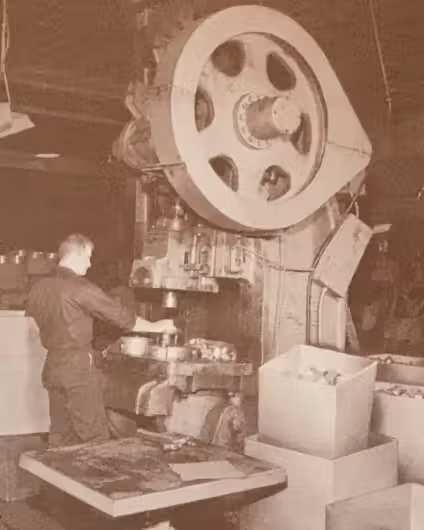
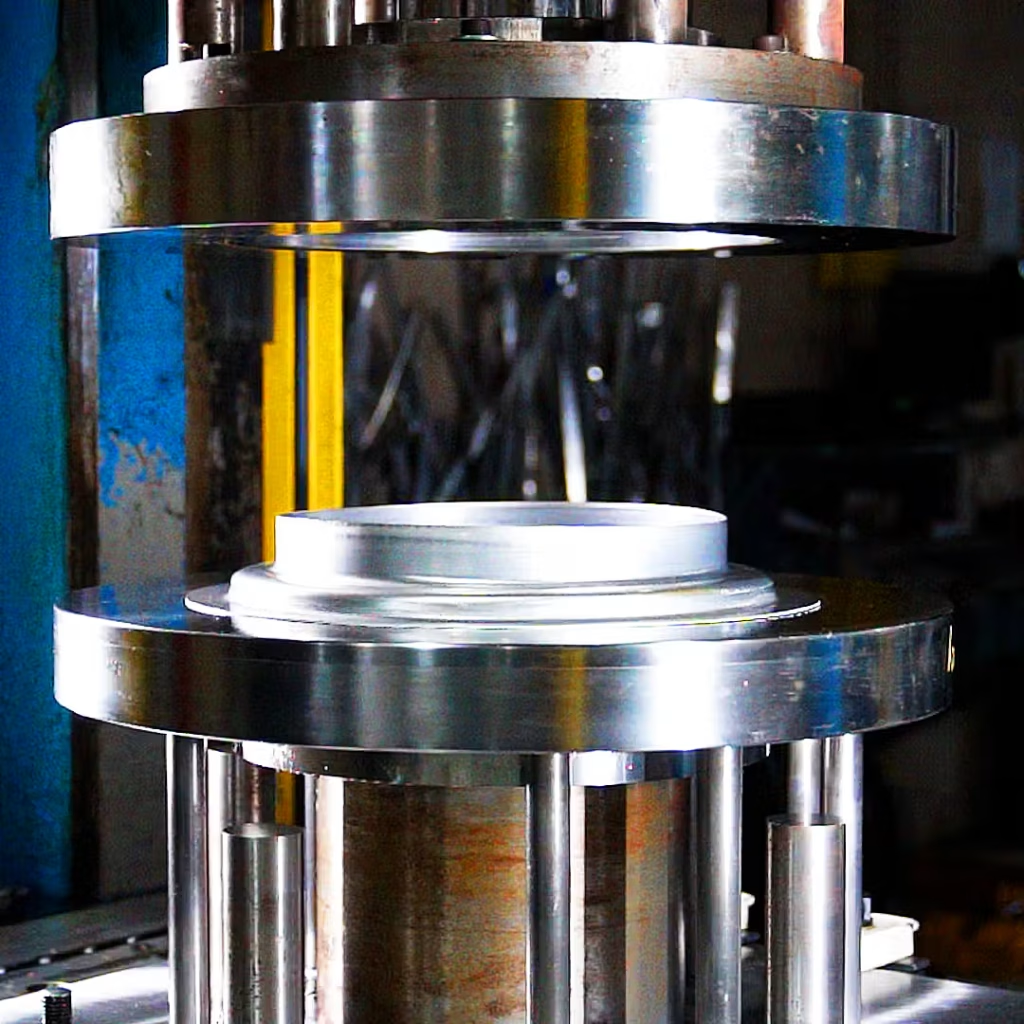
There is little information known on the true origin of deep drawing, but there is evidence that individuals and processes have helped it to become what it is today. The earliest instance of deep drawing is considered to date back to the mid 19th century where Oberlin Smith, an inventor and industrialist, wrote a treatise on deep drawing in 1896 titled, “Press Working of Metals.” He mentions that the deep drawing process likely dates back 50 to 60 years, which would place its origin in the mid 1800s, or 19th century.
Smith and Manville
Oberlin Smith and Eli Manville are two key figured who contributed to the development of the deep draw press as we know it today.
Inventor and Industrialist Oberlin Smith was born in 1840 in Cincinnati, Ohio. Smith started a small machine works and repair ship in Bridgeton, NJ with his cousin, John Burkett Webb. They began by making a variety of applications while simultaneously refitting or fixing broken machines and parts. While working on various machinery and equipment, Smith recognized that he could design a more efficient foot-operated press. This marked the beginning of his growing success. After Webb too a new direction to pursue a different career, Smith brought in his brother, and together they began manufacturing foot-operated presses for food canning companies.
Within three years, he had developed a new version of the press designed with belt-power operation. Together, they sold seventy-two machines, four different models of both foot-driven, and belt-driven, and in 1877, Ferracute Machine Company was born. Here, they manufactured many forms of machinery, including Smith’s own inventions, but their specialty was metalworking presses. Oberlin Smith was the Chief Engineer and and President of Ferracute, where he designed over 500 types and sizes of machines. He also received over 50 patents for his designs, and wrote his book, “Press Working of Metals.”
He founded his press, die, and machine shop, Ferracute Machine Company, in 1863, where many different metal parts were produced for many years. The company started out on three acres, where they produced pressed metal parts for a variety of industrial machines.
There is also evidence that the deep drawing process has developed from the eyelet process, first introduced by Eli Manville in the mid-1800s. The eyelet process consists of using a blank, preferably out of brass, aluminum, or stainless steel, and pulling the blank through a die with a punch, to form the eyelet’s cylindrical shape. This is very similar to stamping, and deep drawing today. Trimming was often necessary to remove any material that wasn’t needed.
Manville started a manufacturing company with his brother, Frank, and named it Eli Melville Company. Here, they specialized in creating various brass products. When he was producing small brass eyelets, he recognized the need for improvement. The process was slow and needed to be sped up. Because of his need for speed, Manville introduced the first ever transfer presser, which was known at that time as the eyelet machine.
L&G Manufacturing
Between 1863 and 1870, two French immigrants, Charles Lalance and Florian Grosjean began producing porcelain-enamel-covered iron cookware and founded their company L&G Manufacturing near Brooklyn, New York. This was one of the first companies in the U.S. to manufacture these types of products in this way. L&G Manufacturing became well known for improving the process of tin stamping and making mess kids for the Spanish-American War. Unfortunately, their business closed in 1955 after WWII.